
Sumo Charles D
- Posted on
- 23 Views
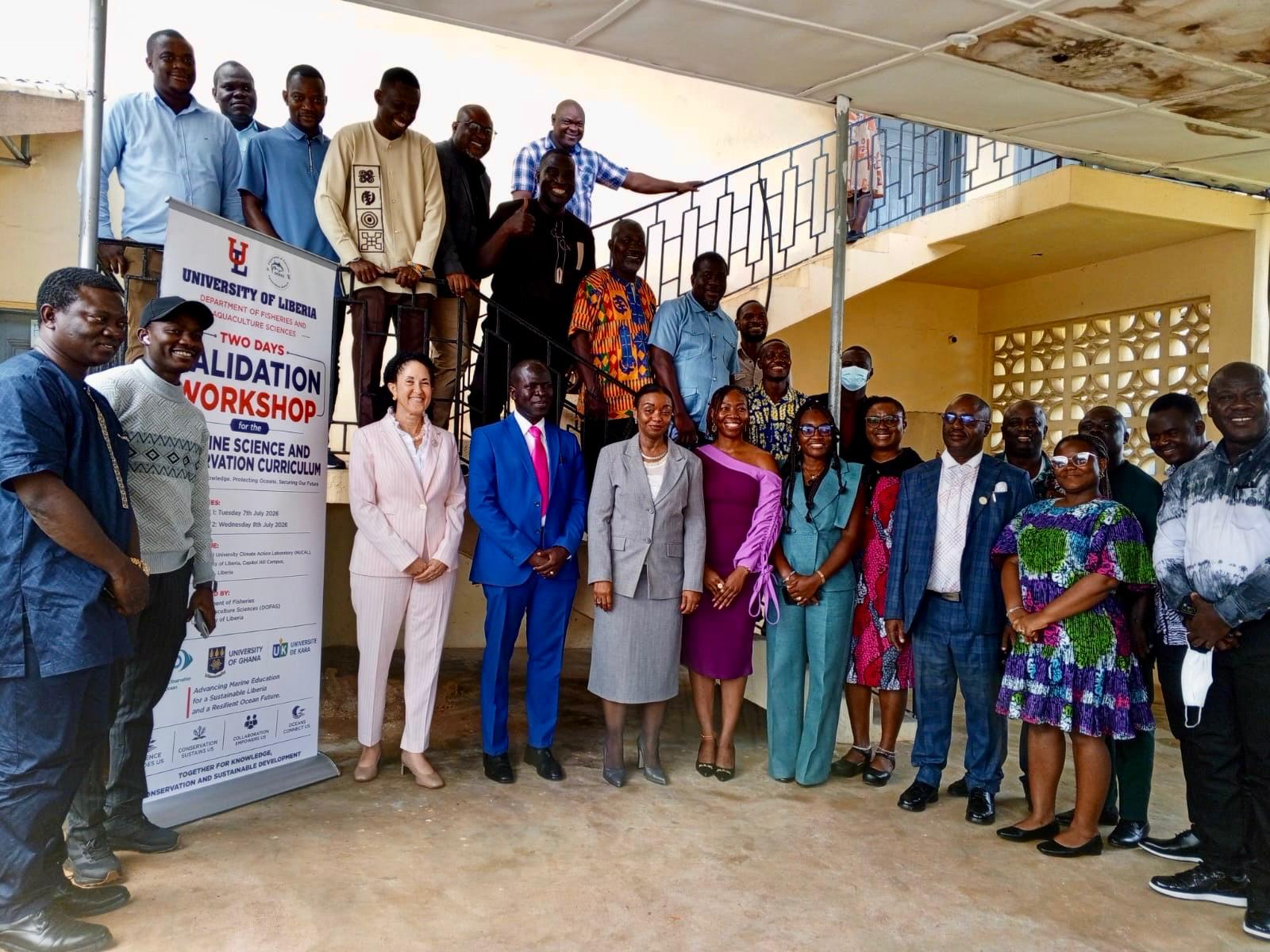
Monrovia, Liberia (July 7, 2026) – The University of Liberia held a two-day workshop this week to validate a proposed bachelor’s degree curriculum in Marine Science and Conservation, a program that will be housed within the Department of Fisheries.
The workshop, held Tuesday and Wednesday on the university’s Capitol Hill campus, brought together representatives of government ministries and agencies, development partners, and faculty and staff of the university’s fisheries department.
The proposed bachelor’s program in Marine Science and Conservation (MSC) is a four-year, full-time undergraduate program to be offered through the College of Science, Technology, Environment, and Climate Change. The program seeks to train graduates to manage and conserve Liberia’s marine and coastal ecosystems, blending strong theoretical science with hands-on practical experience, including laboratory work, field studies, and a geo-information system (GIS). and remote sensing, an internship, and a final-year research thesis.
The curriculum document was prepared in April 2026, the validation workshop is required before submission to the university’s Academic Coordinating Committee (ACC) and Faculty Senate for final approval.
The curriculum is built around four core disciplinary pillars: Marine Biology and Ecology, Oceanography, Marine Conservation, and Marine Policy and Governance. Beyond these four pillars, the curriculum has strong supporting threads running through all four years: GIS and Remote Sensing, Research Methods and Data Analysis, Climate Change, Community Engagement, and Environmental Ethics. It covers approximately 141 credit hours across 8 semesters.
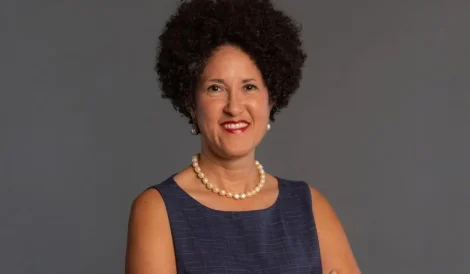
University of Liberia President Dr. Layli Maparyan joined participants at the workshop, pledging the institution’s commitment to developing academic programs that are relevant, responsive, and aligned with national development priorities.
“The proposed curriculum reflects our determination to equip students with the scientific knowledge, technical competencies, and practical skills needed to address emerging challenges in marine conservation, fisheries management, climate change, and the sustainable use of our coastal and marine ecosystems,” the President said.
Dr. Maparyan emphasized that the program aligns with Pillar Five of the Liberian Government’s Agriculture, Road, Rule of Law, Education, Sanitation, and Tourism (ARREST) Agenda for Inclusive Development (AAID), which focuses on biodiversity protection, responsible natural resource management, and climate resilience.
“Within the ARREST framework, marine and ocean initiatives are actively integrated through,” said President Maparyan, adding that the curriculum represents an investment in Liberia’s environmental sustainability, food security, economic development, and stewardship of marine resources.
According to Dr. Maparyan, curriculum validation is an essential process to ensure that academic programs meet both national and international standards while responding to the needs of industry, government, research institutions, and local communities.
She urged participants to engage openly and constructively, drawing upon their expertise to strengthen the curriculum and ensure its quality and relevance.
Dr. Alvin Jueseah, Chairman of the Department of Fisheries & Aquaculture Sciences (DoFAS), said assuming the ACC and Faculty Senate approve the curriculum promptly after the workshop, the earliest realistic intake would be Academic Year 2026/2027.
He said the curriculum was developed with funding from Partnership for Observation of the Global Ocean (POGO), with external technical assistance from Dr. Benjamin Osei Botwe from the University of Ghana, and Dr. Wilfried Essowè Panassa of the University of Kara-Togo.
Regarding faculty preparation, Chairman Jueseah said some faculty in DoFAS have MPhil – an advanced, research-based postgraduate degree – in Oceanography and also Marine ecology. He said several courses, such as English, Biology, Math, Physics, Chemistry, and some fisheries courses in Years 1 and 2, will be taught by existing departments at the university.
However, he said some new marine science-specific courses will require specialist faculty in areas like Geological oceanography, and GIS/remote sensing, that may not currently exist at UL.
He disclosed that DoFAS plans to use visiting lecturers in the early stages of the program as a short-term bridge while recruiting specialist faculty over time.
He added that DoFAS will actively seek funding and partnerships from local and international partners, including the Food and Agriculture Organization Liberia office, the European Union, Conservation International, the Environmental Justice Foundation, and the West Africa Regional Fisheries Program (WARFP).