
Sumo Charles D
- Posted on
- 1014 Views
Government Officials here present, and all those across the nation who have proudly celebrated International Women’s Day
Development Partners & Diplomatic Partners, especially UN Women, global supporter of IWD
UL Board of Trustees, including Board Chairman Senator Numene T. H. Bartekwa, and most especially our esteemed female Trustees,
UL Cabinet Members present, with a special nod to our female Vice Presidents,
UL Faculty members one and all, including ULFA and its female leadership, with special recognition of all female faculty members
UL staff members one and all, including ULSA and its female leaders, with special recognition of all female staff members
UL students, my heartbeat, with a special nod to UL’s female students but also all of UL’s many male students who uphold the values of #HeforShe
Members of the Fourth Estate, including female journalists within the sound of my voice,
Distinguished Guests One and All
Ladies and Gentlemen
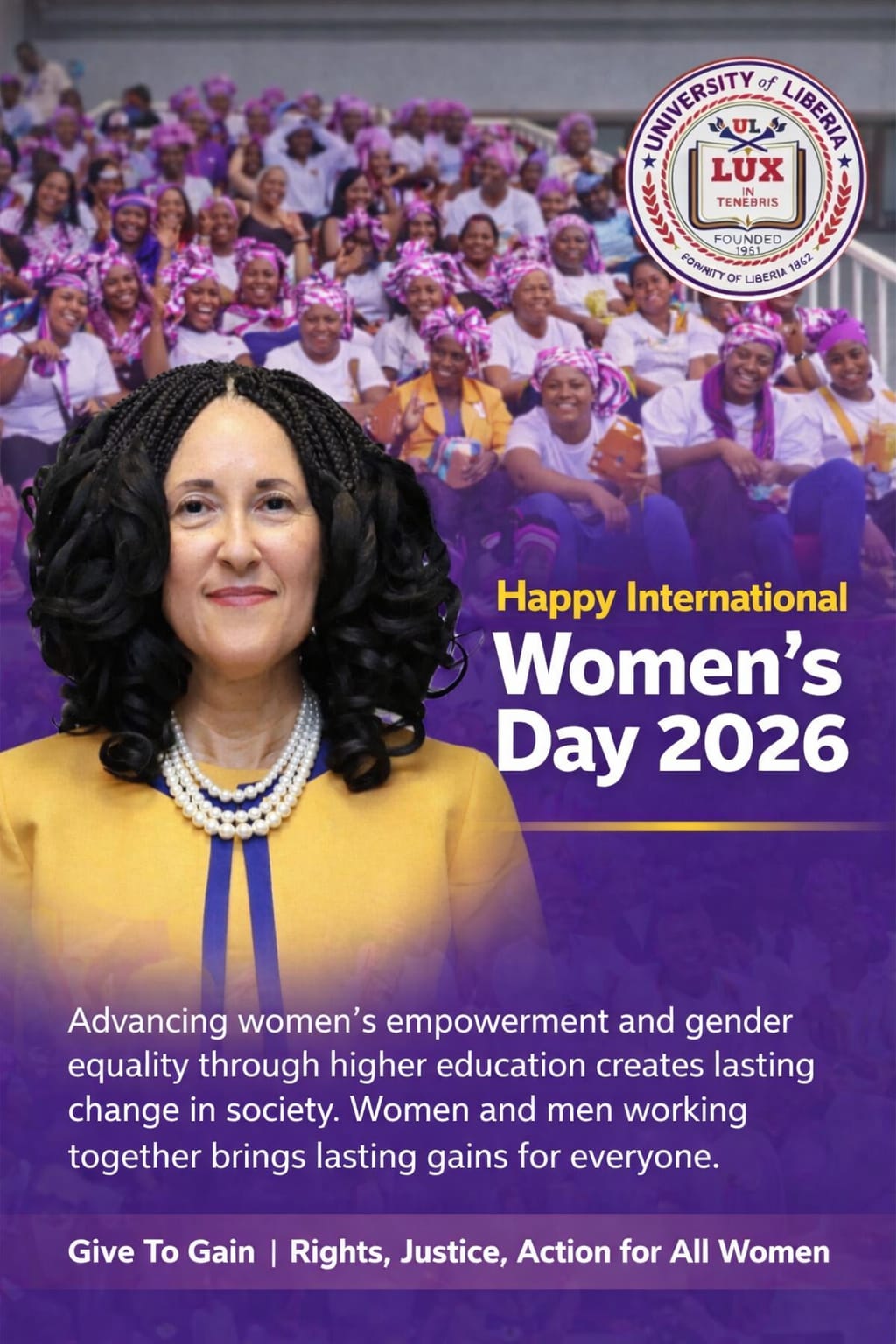
Welcome to UL’s celebration of International Women’s Day 2026. Let me begin by thanking those of you who attended the national International Women’s Day celebration at SKD on Friday. You represented UL well, and you showed the solidarity of UL women. We are a powerful force, and we must know that about ourselves! I wear this purple lappa today in honor of you and in gratitude to you.
Since the day I arrived at UL, gender has been one of my top priorities. In my scholarly life, for over three decades, women and women’s perspectives on social change have been at the center of my work. Women of African descent, in particular, have been my focus. We have a particular view on how to make change in the world, and a particular methodology. We have held so much together for so many for so long that we are among the unsung heroes – or should I say heroines – of the human race. We are family people – mothers, daughters, sisters, aunts, wives, grandmothers, great grandmothers, friends, and co-workers. Our approach to making the world a better place is informed by our roles – and our power – in families. We apply the special knowledge we gain from making families work to making communities work, workplaces work, and society work. We don’t always get credit, but we know what we do. From being mothers, daughters, sisters, wives, members and leaders of women’s societies, we have gained a rich and valuable knowledge. We are also spiritual people – whether Christian, Muslim, Baha’i, traditionalists, or something else – and we know how to work the forces of the universe and make things happen by calling on the Creator. In a world where many have tuned the Creator out, we have had the wisdom to stay connected and call on that Higher Power to help us move things that need moving. People may wonder how we do it, but we know how we do it. No matter what the world tells us, we must continue to know what we know and do what we do. Mark my words, our knowledge and wisdom will be even more necessary in times to come, because we are the conflict-solvers, the healers, the rescuers, and the ones who make a way out of no way. In African universities, such as the University of Liberia, our words and ways must be reposed and have a hospitable home so that our ways can educate the world.
Let’s talk about UL. The ways in which UL needs to improve gender-wise. Just based on my observations since arriving at the beginning of last year – and also based on some of my work with the university in years past, I have some observations.
For starters, we need more gender equality by the numbers. Among students, males still outnumber females and, in male dominated fields such as STEM, male students greatly outnumber female students. Within the faculty, male faculty greatly outnumber female faculty, particularly the higher up you go in the academic ranking system. How many female full professors do we have, for example? How many female associate professors? Assistant professors? We need to equalize – which is hard, because there are many more men seeking jobs at UL than women, many more male than female faculty members taking advantage of study leave to obtain advanced degrees. On the staff side, things are slightly more equal numerically, but I still observe women speaking up less in meetings and waiting for the men to finish before they jump in. There is nothing wrong with culture or respect, except when it deprives the world of women’s genius. So we must look at that and ask questions about it.
In terms of senior administration, we are not doing too badly – the Cabinet is 40% female and 60% male, and the ratio is improved mathematically when I as female president am included in the calculation. But I am most concerned with students, faculty, and staff. I will also observe that in student political leadership, particularly of the student political parties, which are technically banned but are still, for all intents and purposes, operating, female leadership is in short supply. The ULSIL President, who just graduated, is a woman, as is the Financial Secretary. A few of the parties, however, have no women in leadership. I am thankful that ULFA leadership is gender-balanced and that ULSA leadership is inclusive and I hope those trends continue.
It’s not just about the numbers, though. Let’s turn to women’s experiences in the UL educational ecosystem. Based on the anecdotal evidence, women, whether students, faculty, or staff, are frequently subjected to pressures – sexual pressures, financial pressures, and other kinds of pressures – by those who have more power over them in terms of status, position, or money. There is an inordinate amount of quid pro quo – “I’ll do this for you if you do that for me” – going on. Female students should never be asked or pressured to do anything sexual or financial for grades or any other academic benefit, and yet, they still are. Female faculty and staff should never be asked to engage in ethically questionable financial or administrative practices that benefit senior colleagues, male peers, or even outsiders, and yet they are. For the record, males also should not be asked for these things, but today our focus is women, who are more vulnerable in men in these scenarios due to systemic imbalances in social power.
Aside from quid pro quo, SGBV still happens on and off our campuses. Sexual assaults take place, intimate partner abuse still takes place, sexual harassment and bullying still take place, and now I must mention all of the forms of online harassment that take place, from cyberstalking and gendered cyberbullying, to unauthorized sharing of intimate images, to online sexual harassment and more. I’m sure that many of you sitting in this audience today have experienced it.
I must also mention SEA – sexual exploitation and abuse – which refers to all of the ways that people are exploited sexually for financial gain or in financial transactions. We have all heard of female university students exchanging sex for school fees and maintenance money while they are getting their education. There are even movies about this! We don’t like to expose such things, but we know they happen. Yet should any female student have to do this? The answer is clearly no. And, worse, what about those female university students who turn to sexual services for cash or gifts here and there? We don’t like to talk about these things, but if we don’t talk about them, we can’t change them. Lastly, there are those forms of SGBV that many people write off, such as off-color and misogynistic jokes, in response to which we may laugh, even though, on the inside, we are cringing. These things are no joke! How we speak to each other matters, and how represent one another in our speech matters.
As UL President, I want to fix these things. We need to strengthen our policies. We need to strengthen our accountability systems. We need to increase our messaging about these issues, and we need to educate our community with more messaging (on our walls and on social media), in-person workshops, and online trainings. While there are signs all over campus proclaiming “Stop Sexual Harassment” and the like, the signs are old, showing neglect and perhaps a decrease in institutional focus on the issues. It is time to freshen them up and modernize them so that they reflect the realities and graphic trends of today. Even our new H.R. manual, which will be presented to the wider UL community very soon for review and comment, needed a very significant overhaul in terms of how it deals with gender-related issues.
As I said in my inauguration speech, gender is one of my priorities, women’s empowerment is one of my priorities. It is not against men, it is just for women. My role as UL President is to lift everyone, and solving the problems that are unique to women is part of that job. I feel certain that, as we make the world better for women, we are making it better for everyone, and that fact will prove itself as we progress in the direction of gender equality and women’s empowerment.
To these ends, one of my first gender-related acts as UL President was to establish the Office of Gender Equality and Women’s Empowerment – OGEWE – and to appoint its inaugural director, Ms. Janet Y. Lolemeh. This office, established last July, adds to UL’s social inclusion infrastructure, something we are putting in place to make sure that all students, faculty, and staff succeed regardless of gender, ability, background, faith, or other personal characteristics. As the nation’s largest and most accessible institution of higher learning as well as the nation’s flagship, we are bound to ensure that any Liberian can thrive here. That is why I am happy that you will next hear from Ms. Lolemeh about UL’s 75th Anniversary Commitment to women and what the Office of Gender Equality and Women’s Empowerment is all about.
Before I close, it is worth noting, indeed, remembering and extolling, that UL has a long legacy of women’s leadership, going as far back as its 1951 University Charter, which was co-authored and co-implemented by UL President Dr. J. Max Bond and UL Dean of Administration, Anna E. Cooper – she, a scientist who had worked at Liberia College since 1929 and retired from the University of Liberia 1956 – through such luminaries as UL’s 1st female president, Dr. Antoinette Brown Sherman from 1978-1984, UL’s 1st female Law School Dean, Luvenia Ash-Thompson from 1992-1996, UL’s 2nd female President, Dr. Ophelia Inez Weeks in 2017-2019, and many, many other prominent figures. Today, we can be proud of UL’s 2nd female Dean of the Law School, Dr. Niveda C. Ricks-Onuoha, and its 3rd female president, standing here. Some of you sitting here today will continue this history in the future, and, in fact, you are already part of it now.
To all those past and present who have insured that International Women’s Day is recognized at UL, I thank you. To all those, past and present, who have committed to the cause of advancing women and achieving gender equality at UL – and in the wider society – I thank you. To all of you who, as a result of today’s program, will think of gender equality and women’s empowerment in ways you didn’t before and will now join the movement, I thank you. May God bless gender equality and women’s empowerment, may God bless UL, and may God bless the Republic of Liberia. Thank you!!